

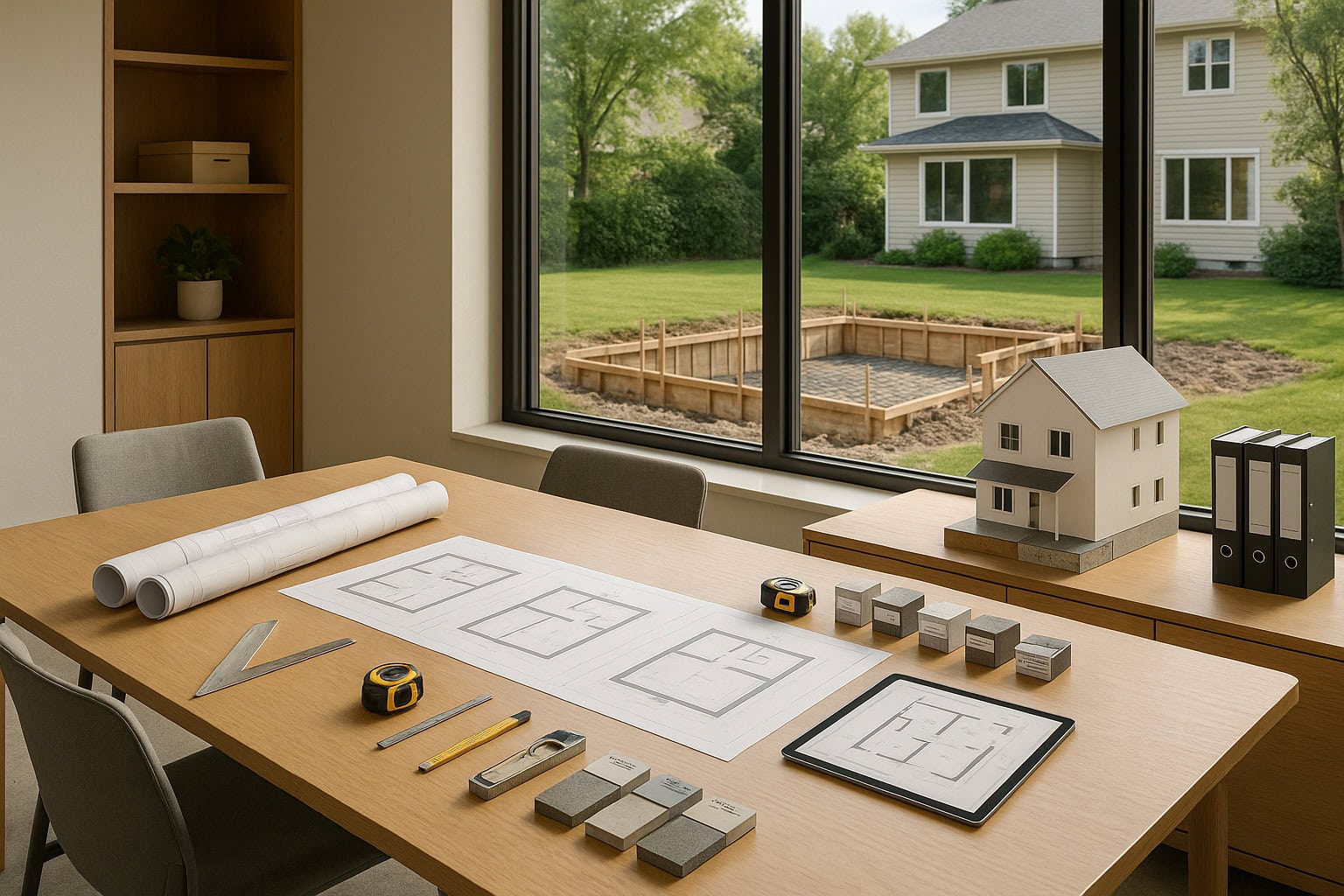
Feasibility First-Align Scope & Budget
Selecting the right home addition foundation options is a decision rooted in disciplined planning, not guesswork. At LivCo, we start every foundation discussion with feasibility design, defining a realistic project budget as the first step-not the last. Whether you’re adding a bedroom, expanding your kitchen, or planning a new mudroom, the foundation type decides both upfront costs and long-term value. Cost is a design input, not an afterthought. By clarifying foundation choices early, we protect clients from future surprises and ensure designs align with what’s possible-not what’s assumed.
Our feasibility design phase defines a clear budget before construction begins. We align scope, materials, and priorities with real costs so every decision is grounded in numbers-not guesswork.
In this crucial phase, we map out scope options based on your goals. If you’re exploring a bedroom addition or upsizing with a second story, we outline each approach and discuss the implications for excavation, shoring, and engineering. We present rough order of magnitude (ROM) pricing bands for every viable foundation choice-whether that’s a monolithic slab, crawlspace, or full basement. These early figures help establish a cost baseline tied to specific scope, laying the groundwork for value-engineering decisions such as minimizing excavation or choosing cost-effective materials.
Establish the budget in feasibility, then manage it actively through design. Foundation choices are discussed in the context of long-term durability, local conditions, and budget parameters. It’s about guiding each client to a solution that makes sense for their family and financial plan. If you’re planning a home addition, your foundation choice is not just a technical decision-it’s a strategic financial one. We’ll help you set the baseline now so you can build with clarity.
Scope, Challenges, and the Role of Feasibility in Foundation Selection
Why does foundation selection matter so much? Every home, lot, and addition type presents unique structural and site challenges. Soil conditions, existing structures, utility access, and local building codes all influence your options and costs. In feasibility, we identify these variables and analyze how they impact the home addition foundation options on your table.
We help clients understand which foundation approaches are viable for their lot and desired addition. This avoids costlier redesigns and eliminates uncertainty before you start construction. We also review FEMA’s guidance for foundation resilience, which is especially valuable in high-risk environments.
Feasibility Deliverables for Foundation Selection
Our feasibility package addresses four deliverables: scope options, ROM pricing bands, value-engineering choices, and a preliminary cost baseline aligned with your intended scope. These outputs empower you to choose between, for example, a crawlspace or a full basement-each with its impacts on schedule, risk, and budget. Ready to evaluate home addition foundation options with clarity? Schedule a feasibility consult to define your budget before you build.
Design with Cost Checkpoints
With feasibility complete and scope established, we advance to design, where real costs continue to guide every decision. No foundation choice is final until it fits both your vision and the budget checked at each milestone. Whether your project is a new mudroom, bedroom, or second-story addition, each evolution of the design is measured against hard numbers-not just design intent. This disciplined, process-driven approach reduces owner risk and enables smarter trade-offs up-front rather than midstream.
Throughout detailed design, we treat the budget as a live document. Scheduled cost checkpoints at key milestones confirm scope against budget and capture value-engineering trade-offs.
Cost Checkpoints Across the Design Phases
LivCo’s defined cost gates ensure your project stays on track from the first drawing to final documents. We set these checkpoints after Schematic Design, after Design Development, at approximately 50% Construction Documents, and at approximately 90% Construction Documents. Each check realigns scope, materials, and systems against the evolving budget and clarifies the impact of your chosen foundation system. At each gate, we document trade-offs: Should we reduce basement depth to trim costs? Would a hybrid pier-and-beam approach save money compared to a full slab?
Early cost alignment reduces the likelihood of costly redesigns or scope reductions later. As the design matures, so does certainty around required excavation, concrete volume, insulation, moisture control, and engineering tolerances. Every cost checkpoint reinforces your foundation selection-balancing the technical requirements with your investment goals.
Hypothetical Numeric Tightening Example
Consider an illustrative cost tightening scenario: At feasibility, initial ROM pricing for a two-room home addition with a crawlspace might be €120k–€140k. As we reach Design Development, sharper engineering and finishes selections reduce the spread to €132k–€136k. By the time we finalize 90% Construction Documents, decisions are definitive and pricing narrows to €134.8k. At this stage, price is locked before construction, ensuring controlled risk and minimized surprises. This model demonstrates how commitment to cost management produces clarity-not guarantees, but real precision-across the design lifecycle.
Design-stage clarity directly informs your foundation selection. Revisit your options at each milestone and use these checkpoints to finalize or reconsider foundation types. Whether you’re investigating the differences between a poured slab, crawlspace, or deep foundation, checkpoints keep your budget and scope in parallel.
Foundation Options in the Design Context
During design, we continue to compare home addition foundation options-evaluating shallow slabs versus deeper basements, pier-and-beam designs, insulated forms, or modular block systems. The impacts on utility integration, site disruption, and vertical load paths all become clearer as drawings and specifications mature. Engaging with the budget at each phase means you can confidently refine your foundation approach, knowing the numbers will drive the solution.
Curious how a specific foundation type could influence your project? Learn more about our architecture and design philosophy at this page and see how cost integration can shape every technical choice.
Pre-Construction Price Lock
By the time you reach the pre-construction phase, uncertainty is minimized. This stage is where drawings are finalized, specifications are set, and allowances are clarified-especially for foundation components and sitework. For our clients considering various home addition foundation options, this means the details governing everything from footings to vapor barriers to moisture management are now papered, and so is the price.
Before we start construction, we finalize drawings and specifications, clarify allowances, and lock the price on paper. This approach reduces owner risk and minimizes the need for contingencies.
Here’s where cost protection is real-not theoretical. We lock pricing before we mobilize. This incorporates material pricing, labor rates, and defined contingencies for potential site issues identified in prior phases. Allowances are clarified for items like underpinning, waterproofing, or special insulation, reducing the risk of budget drift in the field.
Finalizing the foundation selection now ensures that scope, budget, and construction approach stay aligned. If your plans change at this stage, documented change management protocols ensure clarity on costs, time, and implications for all parties. For example, if you decide, late in design, to upgrade from a conventional slab to a full basement, cost and schedule effects are explicit-no surprises, no hidden change orders.
Locking Foundation Scope Before Breaking Ground
This disciplined approach means foundation engineering, permitting requirements, and municipal reviews are fully addressed before starting. Your foundation type, dimensions, materials, and installation logistics are all locked. This limits ambiguity, lowering risk and enabling builders to plan logistics around clear, documented specs.
Ready to secure your plans and pricing before mobilization? We encourage homeowners to engage in pre-construction planning for all major home addition foundation options. It cuts surprises, supports predictable scheduling, and means fewer need for broad contingencies.
Build with Confidence
With documentation complete and price secured, construction becomes disciplined execution against plan-not budget discovery in the field. Our team coordinates with engineering and site supervisors to control scope, manage thermal and moisture details, and ensure installation matches what’s been documented and priced.
Every home addition foundation option presents unique execution requirements. A monolithic slab may require careful weather monitoring. Deep piers-or a partial basement-call for vigilant soil inspections and coordinated trade sequencing. What doesn’t change is our commitment to scope control and documented change management. All modifications are tracked, priced, and approved in writing before implementation, so expectations stay aligned.
Because we’ve addressed most risk factors-including soil bearing capacity, drainage, and local zoning-during feasibility and design, the need for reserves is lower. Our standard is to right-size a modest reserve targeted to known unknowns, like concealed site conditions, after design is complete. We avoid broad contingency budgets and instead rely on the discipline of process and up-front planning.
Want to see how this detailed process applies to a specific project type? Explore our second-story addition process at this link and discover how we manage foundation risk at each stage.
Stable Execution-From Groundwork to Turnover
Construction is all about translating the papered plan to reality. Our integrated project management focuses on risk mitigation and controlled execution for every home addition foundation selected. You benefit from predictable schedules, clear documentation, and minimized change orders-whether your project features a simple slab or a complex pier system.
When you build with LivCo, you’re building with confidence. Fewer surprises, lower owner risk, and a process driven by experience, numbers, and diligence.
Summary of Home Addition Foundation Options
A quick recap: Thorough feasibility design clarifies which home addition foundation options will truly work for your site. Design with cost checkpoints narrows risk and eliminates surprises. Pre-construction price lock means real security before you mobilize. And disciplined construction delivers on the documented plan, not wishful thinking.
For tailored advice on crawlspaces, slabs, or basements-whether for a bedroom, mudroom, or major expansion-LivCo’s process ensures every owner achieves balanced risk and value.
Final Tips and Planning Guidance
For your next project, plan your home addition’s foundation with budget and risk management in mind. Demand a process with early feasibility, live cost checkpoints, and price lock before breaking ground. This disciplined approach brings clarity-and confidence-to every addition.
Schedule a feasibility consult to define your budget before you build.
FAQ
Why is choosing the right home addition foundation so important?
Choosing the right foundation is crucial because it affects your home’s stability, longevity, and overall value. In addition, the right choice can help you avoid common issues like uneven settling or moisture damage. Our team at Liv Companies guides clients through every phase, making sure your investment stands the test of time.
What are the most common challenges when selecting a foundation for a home addition?
Challenges often include navigating soil conditions, matching the existing structure, and complying with local building codes. Furthermore, budget and space limitations may influence your options. Our experts assess all these factors, so your home addition foundation options align perfectly with your needs.
Which types of foundations are available for home additions?
Homeowners can choose from several types, such as slab-on-grade, crawl space, and full basement foundations. Each solution offers distinct benefits. For example, a crawl space can provide easier access to utilities, while a basement may add valuable living space. We’ll help you weigh the pros and cons of each.
How do I compare different foundation options for my project?
To compare options, consider factors such as cost, durability, local soil conditions, and future maintenance. Additionally, think about how each foundation type will integrate with your existing home. We provide detailed comparisons, so you can make an informed decision with confidence.
What final tips should I keep in mind when planning my home addition’s foundation?
Start by consulting with qualified professionals, like our team at Liv Companies. Moreover, prioritize proper site evaluation, realistic budgeting, and compliance with local regulations. By planning ahead and weighing all your home addition foundation options, you’ll set your addition up for lasting success.